
Have you ever had the same thought running through your mind again and again?
A conversation you keep replaying.
A problem you cannot solve right now.
A worry about something that may never happen.
The thought keeps returning—and slowly, it drains your mental energy.
This is where “Blanking Unnecessary Thoughts” can become a useful Thought Management practice.
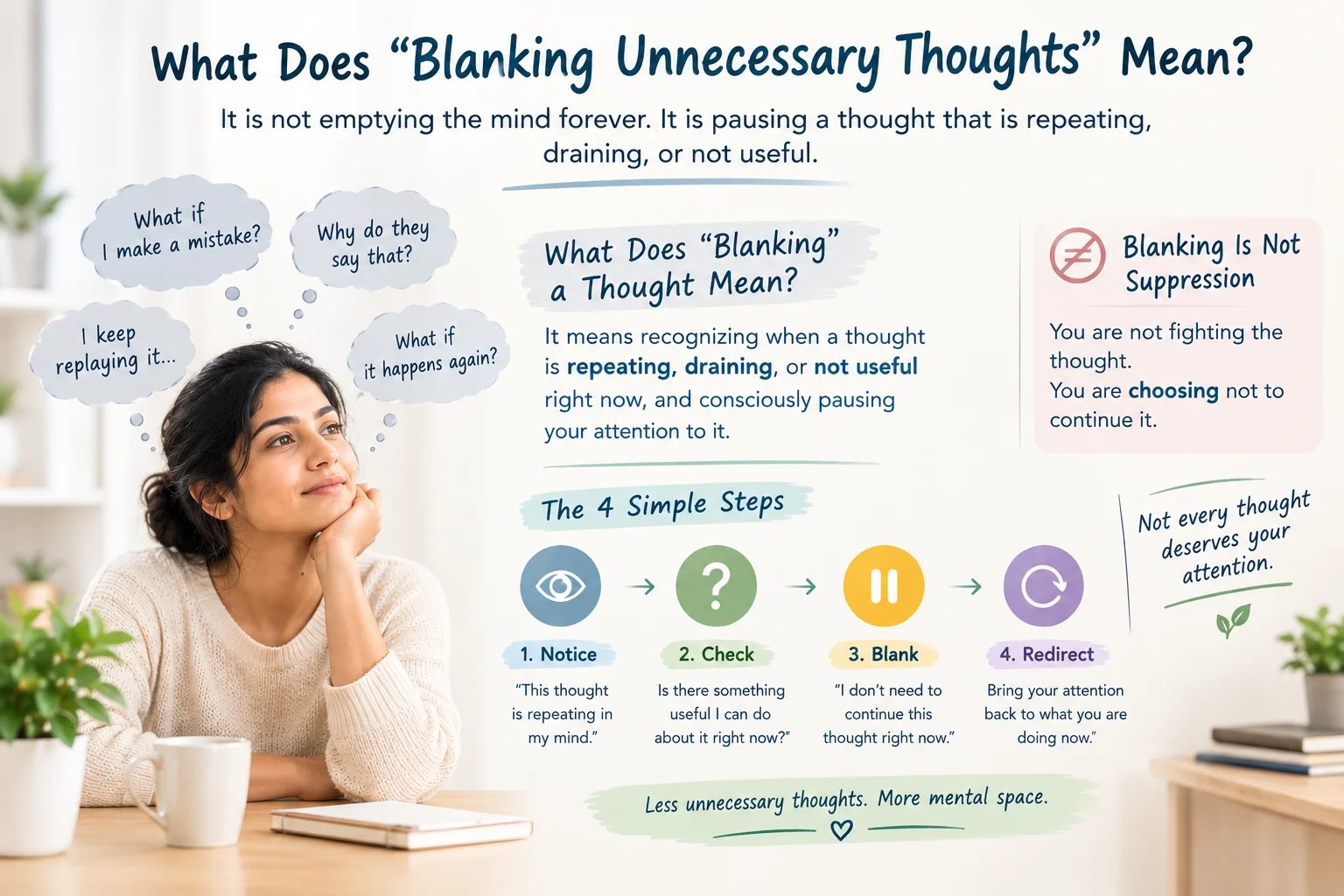
What Does “Blanking” a Thought Mean?
Blanking an unnecessary thought does not mean emptying your mind forever.
It means recognizing when a thought is repeating, draining, or not useful right now, and consciously pausing your attention to it.
For example:
“What if I make a mistake tomorrow?”
If there is something you can prepare or do, take action.
But if you have already done what you can and the thought keeps repeating, you can tell yourself:
“I don’t need to continue this thought right now.”
Then redirect your attention to the present.
Blanking Is Not Suppression
There is an important difference between fighting a thought and blanking an unnecessary thought.
Suppression can sound like:
“I must not think about this.”
That can make you focus on the thought even more.
Blanking is different.
You notice the thought, recognize that it isn’t useful at that moment, and stop feeding it with additional attention.
You are not fighting the thought.
You are choosing not to continue it.
How to Blank an Unnecessary Thought
Try this simple process:
1. Notice
“This thought is repeating in my mind.”
2. Check
Ask:
“Is there something useful I can do about it right now?”
3. Blank
If there is no useful action, say:
“I don’t need to continue this thought right now.”
4. Redirect
Bring your attention back to what you are doing.
Your work.
Your conversation.
Your family.
Your breathing.
The present moment.
A Simple Example
Imagine someone says something that hurts you.
Later, you keep replaying their words:
“Why did they say that?”
“I should have replied differently.”
“What if they do it again?”
You may not be able to solve the situation by thinking about it repeatedly.
Ask:
“Is this thinking helping me take action, or am I simply replaying it?”
If there is an action you need to take, take it.
If not, you can blank the unnecessary repetition and redirect your attention.
When Should You Blank a Thought?
A simple filter can help:
Useful thought → Think → Decide → Act
Unnecessary thought → Notice → Blank → Redirect
The goal is not to have fewer thoughts.
The goal is to stop unnecessary thoughts from taking more attention than they deserve.
Remember
Blanking unnecessary thoughts is not about creating an empty mind.
It is about creating mental space.
You don’t have to solve every thought.
You don’t have to follow every thought.
And you don’t have to keep repeating a thought simply because it appeared.
Notice it. Check it. Blank what is unnecessary. Redirect your attention.
That is a simple step toward greater mental clarity.