
Social media can be a wonderful tool. It helps us learn, connect with people, discover ideas, and share our own experiences.
But there is another side that isn’t always obvious.
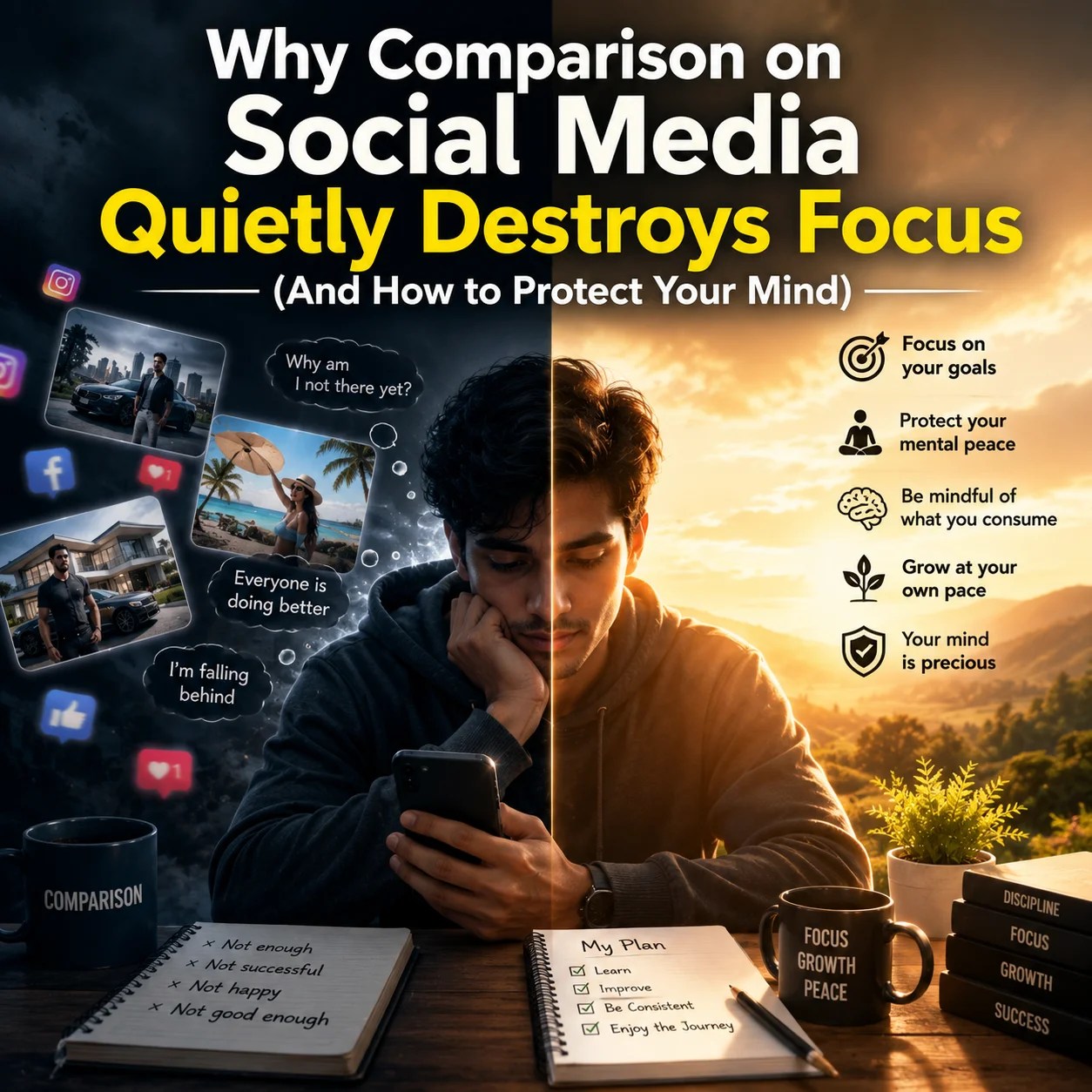
You open Instagram for five minutes. You see someone travelling, someone buying a new car, someone celebrating a promotion, someone building a successful business, or someone seemingly living the perfect life.
You put your phone down and suddenly think:
“Am I falling behind?”
Nothing about your own life may have changed in those five minutes. Yet your mind feels different.
This is the hidden effect of social media comparison.
We Compare Our Reality With Someone Else’s Highlight Reel
One of the biggest problems with social media is that we rarely see the complete picture.
We see:
- The successful business, not the years of struggle.
- The beautiful holiday, not the financial stress behind it.
- The achievement, not the failures that came before it.
- The happy relationship, not the difficult conversations.
- The confident person, not their private insecurities.
We compare the behind-the-scenes of our own life with the highlight reel of someone else’s life.
That comparison can never be fair.
How Comparison Quietly Destroys Your Focus
1. It Shifts Your Attention From Your Goals
You may have started the day with a clear goal.
You wanted to study, work on a project, exercise, or build something meaningful.
Then you start scrolling.
Suddenly, your mind is no longer focused on your goal. It is thinking about someone else’s success.
You start asking:
“Why am I not there yet?”
Instead of working toward your destination, you’re constantly checking where everyone else is going.
2. It Makes You Feel Behind
Everyone has a different timeline.
One person may succeed at 22.
Another may discover their purpose at 35.
Someone may build a business in five years.
Someone else may spend ten years learning before seeing results.
Social media makes these different journeys appear to happen simultaneously.
You see hundreds of people’s achievements in a few minutes.
Your brain can interpret this as:
“Everyone is moving forward except me.”
But that’s an illusion created by the amount of information you’re consuming.
3. It Creates Unrealistic Expectations
Constant exposure to carefully edited lives can quietly change your definition of success.
You may begin believing that you need:
- More money.
- A better body.
- A bigger house.
- More followers.
- Better clothes.
- More travel.
- More recognition.
And even when you achieve something, the satisfaction may disappear quickly because there’s always someone online who appears to have more.
The finish line keeps moving.
4. It Turns Inspiration Into Pressure
Social media comparison isn’t always negative.
Sometimes someone else’s success genuinely inspires us.
The problem begins when inspiration changes into pressure.
Instead of thinking:
“If they can do it, maybe I can learn from them.”
You think:
“Why haven’t I done it yet?”
One thought encourages growth.
The other creates unnecessary stress.
Learn to recognize the difference.
5. It Makes You Chase Other People’s Goals
This is perhaps the most dangerous form of comparison.
You see someone becoming successful in a particular career and suddenly believe you should do the same.
You see someone building a business and feel that you should start one.
You see someone travelling constantly and wonder why your life isn’t like theirs.
But ask yourself:
“Do I actually want this, or did I learn to want it because I keep seeing it?”
Not every popular goal is your goal.
Not every successful lifestyle is the right lifestyle for you.
How to Protect Your Mind From Social Media Comparison
1. Curate What You Consume
Your social media feed influences your mental environment.
If certain accounts consistently make you feel inadequate, anxious, or distracted, you don’t have to keep consuming their content.
Unfollow, mute, or reduce exposure to accounts that negatively affect your mindset.
Follow people who:
- Teach you something useful.
- Encourage healthy growth.
- Share realistic experiences.
- Inspire you without making you feel inferior.
Your attention is valuable. Treat it that way.
2. Don’t Start Your Day With Social Media
The first information you consume in the morning can influence where your attention goes.
If the first thing you see is hundreds of other people’s lives, your mind can immediately enter comparison mode.
Instead, start your day with something connected to your own priorities.
Read.
Write.
Exercise.
Plan your day.
Sit quietly.
Work on something meaningful.
Give your mind a chance to belong to you before giving it to the internet.
3. Create a “Comparison Check”
Whenever you notice yourself feeling inadequate after scrolling, stop for a moment.
Ask:
“What exactly am I comparing?”
Then ask:
“Do I know the full story behind what I’m seeing?”
Finally:
“What can I do in my own life instead of thinking about theirs?”
This brings your attention back to reality.
4. Measure Yourself Against Your Past Self
Instead of asking:
“Am I ahead of them?”
Ask:
“Am I moving forward compared with who I was?”
Did you learn something new?
Did you become more disciplined?
Did you improve your skills?
Did you take better care of yourself?
Did you handle a difficult situation better than you would have previously?
These are meaningful measures of progress.
Your real competition is often not another person.
It is the version of you that you are capable of becoming.
5. Use Social Media With Intention
Before opening an app, ask yourself:
“Why am I opening this?”
Are you looking for information?
Connecting with someone?
Promoting your work?
Taking a short break?
Or are you simply bored?
If you don’t know why you’re opening the app, you may end up scrolling without purpose.
Intentional use gives your attention a direction.
6. Remember: Your Life Doesn’t Need to Look Impressive
A meaningful life doesn’t always look impressive online.
Some of the most important things happen away from cameras:
- Learning a skill.
- Spending time with family.
- Recovering from failure.
- Building your character.
- Reading quietly.
- Saving money.
- Working on a long-term goal.
- Becoming emotionally stronger.
Not everything valuable needs to be posted.
A life doesn’t become meaningful because people can see it.
Your Attention Is Your Life
Every day, you have a limited amount of attention.
Where you repeatedly place that attention influences your thoughts, emotions, and actions.
If you spend hours watching other people’s achievements, lifestyles, opinions, and milestones, you may have less mental space left for your own goals.
That’s why protecting your attention isn’t just about reducing screen time.
It’s about protecting your direction.
Final Thoughts
Social media isn’t the enemy.
Unconscious comparison is.
You don’t need to completely disconnect from the digital world. You simply need to become more conscious of what you allow into your mind.
The next time you see someone else’s success online, pause before comparing.
Instead of thinking:
“Why am I not there?”
Try asking:
“What can I learn from this—and then return to my own path?”
Their journey is theirs.
Your journey is yours.
Stop measuring your life against someone else’s highlight reel. Protect your focus, trust your timeline, and keep building your own story.