
Introduction:
Your Mind Shapes Your Future
Academic success is not determined by intelligence, memory, or hard work alone. The way students think, manage their emotions, and direct their attention also plays an important role in their learning and overall development.
Today, many students struggle with overthinking, examination stress, fear of failure, distractions, lack of concentration, and emotional pressure. Even when students have the ability and willingness to succeed, uncontrolled thoughts can prevent them from performing to their full potential.
This is where Mastering the Thoughts, a mind transformation program by A.T. Rajkumar, Mind & Thought Architect, becomes relevant.
The program introduces students to practical thought-management techniques through the THOT-FO framework, helping them understand their thinking patterns, reduce unnecessary mental distractions, and develop more productive ways of thinking.
The central idea is simple: students should not only learn academic subjects; they should also learn how to manage the minds that help them learn.
Why Thought Management Matters for Students
A student’s mind is constantly processing information, expectations, emotions, memories, and future possibilities. When too many unnecessary thoughts occupy the mind, students may find it difficult to concentrate on what truly matters.
Consider a student preparing for an examination. Instead of concentrating on the subject, the student may repeatedly think:
- What if I fail the examination?
- What if I forget everything I studied?
- What will my parents think about my marks?
- Why am I unable to concentrate?
- What if other students perform better than me?
These repeated thoughts can consume valuable mental attention and make studying more stressful.
Five common challenges students face:
1. Overthinking: Repeatedly analysing situations, worrying about results, and imagining negative outcomes can make even simple academic tasks feel overwhelming.
2. Examination Stress: Fear of failure, expectations, and performance pressure can affect a student’s confidence and ability to approach examinations calmly.
3. Lack of Concentration: Unnecessary thoughts, digital distractions, and difficulty maintaining attention can interrupt the learning process.
4. Emotional Struggles: Anger, disappointment, fear, and frustration can influence how students respond to challenges and interact with others.
5. Mental Exhaustion: Constant worrying and repeated thinking can make students feel mentally tired, even when they have not performed physically demanding activities.
Why does thought management matter?
When students learn to recognise and manage their thinking patterns, they can develop better concentration, emotional awareness, confidence, and decision-making abilities.
Academic improvement is not just about studying for more hours. It is also about developing the mental clarity to make those hours more productive.

What Is THOT-FO? How Does It Work?
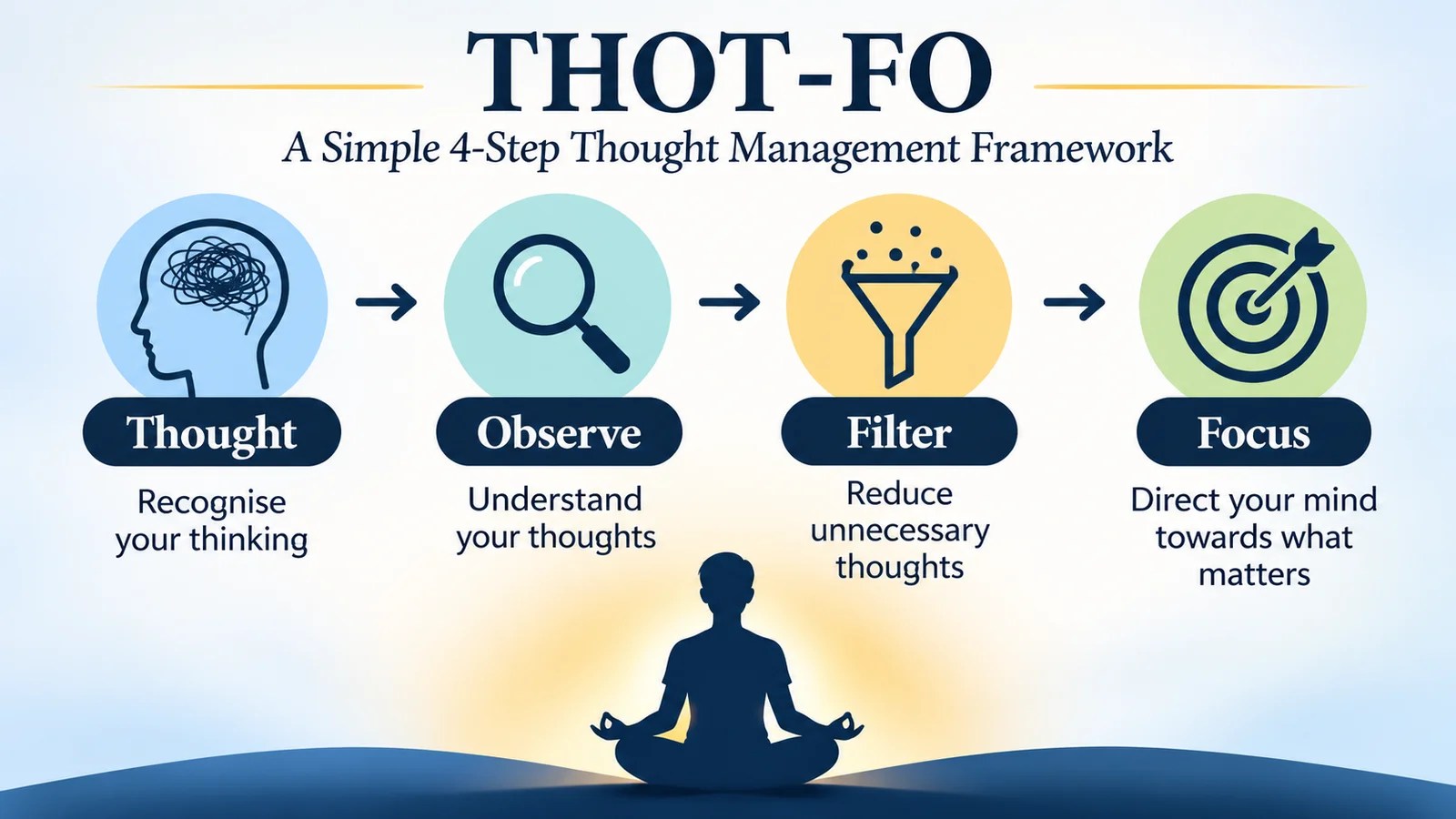
THOT-FO is a practical thought-management framework introduced through A.T. Rajkumar’s approach to mind training. It encourages individuals to become aware of their thoughts, understand their thinking patterns, reduce unnecessary mental activity, and direct their attention towards productive thinking.
The framework focuses on four important steps:
1. THOUGHT – Recognise Your Thinking
The first step is to become aware of what is happening in your mind.
Students often think continuously without noticing how much their thoughts influence their emotions, attention, and behaviour.
For example, a student who repeatedly thinks, “I cannot understand this subject,” may gradually lose confidence and motivation.
Recognising such thoughts is the beginning of developing better control over one’s thinking patterns.
2. OBSERVE – Understand Your Thoughts
The second step is to observe thoughts rather than automatically reacting to every thought that appears.
Students can learn to identify whether their thoughts are useful, repetitive, unnecessary, or connected to fear and worry.
For example, instead of immediately becoming anxious about an upcoming examination, a student can pause and recognise that the mind is producing thoughts about possible failure.
Observation creates an opportunity to respond more consciously.
3. FILTER – Reduce Unnecessary Thoughts
Not every thought deserves your attention.
Students need to understand the difference between thoughts that help them move forward and thoughts that unnecessarily consume their mental energy.
For example:
- Replace repeated worrying about examination results with preparation.
- Reduce comparisons with other students and focus on personal progress.
- Avoid repeatedly thinking about past mistakes and identify what can be learned from them.
- Redirect attention from imagined problems towards practical solutions.
Filtering encourages students to give more attention to productive thinking instead of allowing every unnecessary thought to dominate their minds.
4. FOCUS – Direct Your Mind Towards What Matters
The final step is to direct attention towards meaningful activities and productive thinking.
When studying, focus on the subject rather than worrying about the examination result. When facing a challenge, focus on possible solutions rather than repeatedly thinking about the problem.
Through consistent practice, students can strengthen their ability to direct their attention and approach their responsibilities with greater clarity.
The power of THOT-FO lies in developing awareness of thoughts and learning to direct thinking towards meaningful outcomes.
Program Format and Delivery
Understanding thought management should not remain limited to books or theoretical explanations. Students need opportunities to understand, practise, and apply these techniques in their everyday lives.
The Mastering the Thoughts program can be delivered through different educational formats to meet the needs of students and institutions.
School Programs
Specially designed sessions introduce school students to thought awareness, concentration, positive thinking, emotional understanding, and practical techniques for handling everyday academic challenges.
College Programs
College students often face academic competition, career uncertainty, examination pressure, and concerns about their future. The program helps them understand their thinking patterns and develop a more focused and confident approach towards their goals.
Interactive Workshops
Workshops provide opportunities for students to participate in practical mind exercises, understand common thinking challenges, and explore techniques that can be applied in real-life situations.
Special Educational Events
Thought-management sessions can also be organised as part of student development programs, institutional events, seminars, and awareness initiatives.
Multilingual Learning and Wider Reach
To make thought-management knowledge accessible to more students, programs and learning materials can be delivered in different Indian languages, according to institutional requirements.
The larger objective is to make mental fitness an important part of education.
Just as schools encourage students to develop physical fitness, they should also encourage students to develop mental fitness.
Mindfulness in Action – The Blanking Technique
One of the challenges students experience is the continuous flow of unnecessary thoughts. Even when they sit down to study, their minds may move between past experiences, future worries, personal concerns, and unrelated ideas.
This creates a situation where the student is physically present with the book but mentally occupied somewhere else.
The Blanking the Unnecessary Thoughts technique introduces the importance of consciously pausing unnecessary thinking and bringing attention back to the present moment.
Instead of continuously engaging with every thought, students are encouraged to recognise mental distractions and practise redirecting their attention.
How can students practise this?
- Find a comfortable and relatively quiet place.
- Relax your body and take a few natural, gentle breaths.
- Notice the thoughts currently occupying your mind.
- Recognise unnecessary thoughts without continuously engaging with them.
- Allow a brief mental pause and gently bring your attention back to the present activity.
- Practise this regularly to develop greater awareness of your thinking patterns.
A practical example:
Imagine a student sitting down to study mathematics. After a few minutes, thoughts about an argument with a friend begin to interrupt concentration.
Instead of repeatedly thinking about the incident, the student can recognise the distraction, pause, and consciously redirect attention towards the mathematics problem.
The objective is not to force the mind to become completely thoughtless. It is to develop the ability to avoid unnecessary engagement with distracting thoughts and return to what matters.
A mind that learns to pause can become better prepared to focus.

Outcomes and Evidence – Building a Stronger Student Mindset
The purpose of thought management is not simply to make students think positively. It is to help them develop practical mental skills that support their academic, emotional, and personal growth.
Through consistent application of thought-management practices, students can work towards developing the following abilities.
1. Improved Concentration
Students learn to recognise distractions and bring their attention back to their studies and important activities.
2. Greater Emotional Resilience
Understanding their thoughts can help students respond more consciously to disappointment, criticism, academic pressure, and everyday challenges.
3. Better Decision-Making
When students learn to pause and examine their thinking, they can develop a more thoughtful approach to making decisions instead of reacting immediately to emotions or pressure.
4. Reduced Unnecessary Overthinking
Students can learn to distinguish between productive thinking and repetitive mental activity, helping them spend more attention on practical solutions.
5. Increased Confidence
Developing awareness of negative thinking patterns and practising more constructive responses can support a healthier sense of self-confidence.
6. Better Academic Engagement
Improved awareness, concentration, and mental discipline can help students approach their learning activities with greater consistency.
Evidence and Real-Life Experiences
The effectiveness and practical value of a student development program should be communicated through genuine experiences and evidence.
Schools and institutions can document student feedback, workshop participation, personal experiences, and measurable changes in learning-related behaviours.
Where available, authentic testimonials and case studies can help demonstrate how students have applied thought-management techniques in their daily lives.
The ultimate goal is to help students understand that their minds can be trained through awareness, practice, and consistent effort.
How to Experience Mastering the Thoughts
Every student deserves the opportunity to understand their mind and develop the mental skills needed to face life’s challenges.
The Mastering the Thoughts program by A.T. Rajkumar aims to make practical thought-management knowledge accessible to students, educational institutions, and organisations.
Schools, colleges, and educational organisations can explore opportunities to introduce this program through:
School and College Workshops: Organise dedicated thought-management sessions for students to understand overthinking, concentration, emotional challenges, and mental fitness.
Institutional Partnerships: Collaborate to introduce structured mind-development initiatives that support students beyond traditional academic learning.
Personal Learning: Students and individuals can explore the program to understand their thinking patterns and practise techniques for developing mental clarity.
Learning Resources: Explore books and other learning materials by A.T. Rajkumar to gain a deeper understanding of the mind and thought management.
For program details, learning resources, and institutional enquiries, visit:
Website: https://atrajkumarsmind.com/

Frequently Asked Questions (FAQs)
1. What is Mastering the Thoughts?
Mastering the Thoughts is a mind transformation program by A.T. Rajkumar that introduces practical approaches to understanding and managing thoughts. It focuses on developing concentration, mental clarity, productive thinking, and emotional awareness.
2. What is THOT-FO?
THOT-FO is a four-step thought-management framework: Thought, Observe, Filter, and Focus. It encourages individuals to recognise their thoughts, observe their thinking patterns, filter unnecessary thoughts, and direct their attention towards meaningful activities.
3. How can thought management help students?
Thought management can help students become more aware of unnecessary thinking, manage distractions, develop concentration, respond more thoughtfully to emotional challenges, and approach academic responsibilities with greater clarity.
4. Is Mastering the Thoughts useful for examination stress?
Yes. The program introduces thought-awareness and thought-management practices that students can use when dealing with examination-related worries, fear of failure, and distracting thoughts. It can complement healthy study habits and appropriate support, but it is not a replacement for professional mental health care when needed.
5. Can schools and colleges organise this program?
Yes. Educational institutions can explore workshops, student development sessions, and other suitable program formats based on their requirements.
6. Does thought management mean stopping all thoughts?
No. The objective is not to eliminate every thought. It is to become aware of thinking patterns, reduce unnecessary engagement with distracting thoughts, and direct attention towards productive and meaningful activities.
7. Who can benefit from Mastering the Thoughts?
Students, educators, working professionals, and individuals interested in improving their thought awareness, concentration, and mental clarity can explore the program.
For more insights into thought management, mental fitness, and personal development, have a look at our related blogs below.
1. How to Use the THOT-FO Framework to Improve Focus and Reduce Overthinking
Discover how the four steps of THOT-FO – Thought, Observe, Filter, and Focus – can help you recognise unnecessary thoughts, reduce mental distractions, and develop better concentration in your daily life.
2. What Is the THOT-FO Technique? A Simple Guide to Quieting Mental Noise
Understand the THOT-FO technique, how it works, and how it helps you become more aware of your thoughts, manage mental noise, and develop a calmer and more focused mindset.
3. Blanking the Unnecessary Thoughts: Step-by-Step Practice for Students
Learn how students can practise the Blanking Technique to pause unnecessary thinking, overcome mental distractions, and bring their attention back to studying and other important activities.
4. How Mastering the Thoughts Workshops Benefit Educational Institutions
Explore how Mastering the Thoughts workshops can help schools and colleges promote mental fitness, improve student concentration, develop emotional awareness, and encourage a healthier learning environment.
5. Student Stories: How Mind Management Transformed My Exam Performance
Discover real student experiences and practical insights into how understanding and managing thoughts can help students handle examination pressure, build confidence, and approach their studies with greater clarity.
6. THOT-FO vs Other Mindfulness Techniques: Which Works Best for Students?
Explore the differences between the THOT-FO framework and other mindfulness approaches. Understand their key principles and how students can use different practices to develop awareness, concentration, and mental clarity.
7. 10 Simple Daily Exercises from THOT-FO That Quiet Your Mind
Discover ten practical exercises inspired by THOT-FO that can help you recognise unnecessary thoughts, reduce distractions, improve focus, and build better thought-management habits every day.